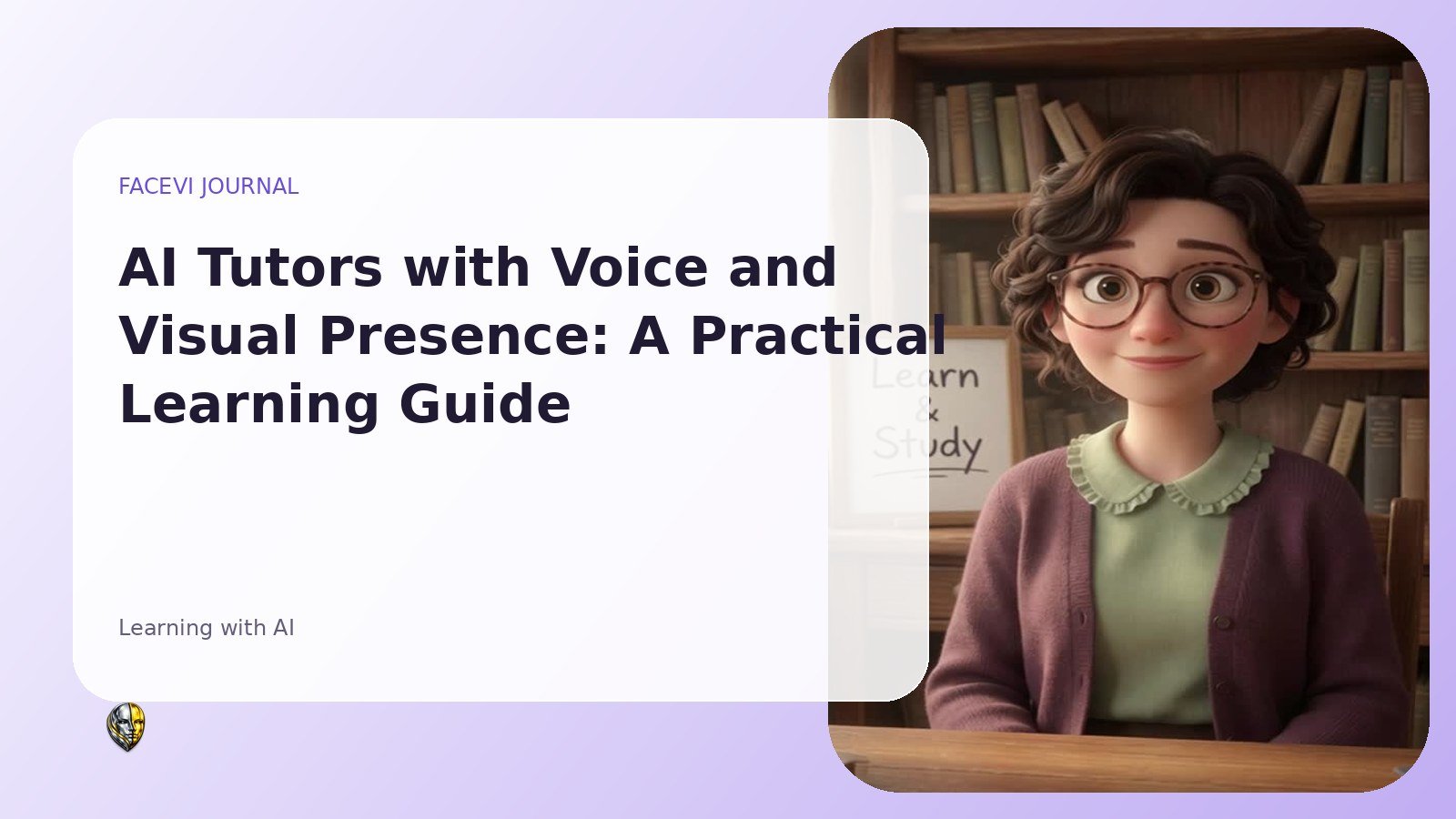
An AI tutor becomes more useful when it feels easy to ask a small question, admit confusion, and try again. Voice input reduces the effort of typing every thought, while a visible character can make the interaction feel structured and attentive. Those features do not automatically create good teaching. Effective learning still depends on clear goals, active practice, accurate feedback, appropriate difficulty, and the learner doing the thinking. FaceVI’s Tutor character is designed to guide rather than simply produce answers. This guide shows students, parents, adult learners, and educators how to use an AI tutor as a practical learning partner while preserving academic honesty, privacy, and independent judgment.
Define the learning goal before starting
Begin with a specific outcome. “Help me with math” is broad; “teach me how to solve linear equations with fractions and give me three practice questions” gives the tutor a useful target. Include the learner’s level, deadline, and what has already been tried. A strong opening message might say that the learner is in Grade 9, understands ordinary equations, becomes confused when denominators appear, and has a quiz on Friday.
The tutor can then choose language and examples that match. Goal definition also makes progress measurable. By the end of the conversation, the learner should be able to demonstrate a skill, explain a concept, correct an error, or produce a plan. The avatar interface can make a session feel natural, but the learning goal keeps it purposeful.
Use explanation, example, attempt, feedback
A reliable tutoring cycle has four parts. First, the tutor explains one idea in simple language. Second, it works through an example while naming the reasoning. Third, the learner attempts a similar problem.
Fourth, the tutor gives specific feedback and decides whether to repeat, simplify, or advance. Asking the AI to provide ten completed examples may feel productive, but it often creates recognition without recall. The learner should have frequent opportunities to answer aloud or type a step. FaceVI can keep spoken responses concise so the learner is not forced to listen to a lecture before participating. When the tutor asks a check-for-understanding question, pause and answer it instead of immediately requesting the solution.
Ask for multiple representations
People understand ideas through different representations. A fraction can be shown as a number, a picture, a ratio, a measurement, or a part of an equation. A historical event can be described chronologically, geographically, politically, and through primary sources.
Ask the tutor to explain the same idea in a second way when the first explanation does not connect. Useful requests include: use a real-life analogy, draw an ASCII diagram, create a small table, compare two concepts, explain it as if I were younger, or give the formal definition after the intuitive one. Multiple representations reveal whether the learner understands the underlying idea or only memorized one wording. They also help the tutor discover which explanation style works best for the current session.
Make the learner retrieve, not only review
Retrieval practice means recalling information without seeing the answer. It strengthens memory more effectively than repeated rereading. Ask the AI tutor to quiz one question at a time, wait for an answer, and then explain mistakes. The learner can speak the answer using push-to-talk, which makes a short quiz feel conversational.
Request mixed questions so the learner must decide which method applies instead of repeating the same procedure. At the end, ask for a brief cumulative check using material from earlier in the session. The conversation history can preserve questions and explanations, but the learner should occasionally close the notes and attempt recall. An AI tutor is most valuable when it creates active thinking rather than becoming a faster answer key.
Use hints before full solutions
When stuck, ask for the smallest useful hint. A hint can identify the next operation, remind the learner of a rule, point out a unit mismatch, or ask a guiding question. If that is not enough, request a stronger hint. Only then review a full solution.
This approach preserves productive struggle, the period in which the learner is challenged but still able to make progress. A strong tutor prompt can enforce this behavior by default. For graded assignments, the learner should share an attempt and ask for feedback on reasoning. The AI can teach the method, identify likely errors, and create a similar practice problem. It should not impersonate the student, complete an assessment against the rules, or generate work intended to be submitted as the learner’s own.
Correct errors without creating shame
Errors are evidence about the learner’s current model. A useful tutor identifies exactly where the reasoning changed direction, explains why that step does not follow, and gives the learner another chance. Generic praise such as “great job” after every message can feel artificial.
Specific feedback is more credible: the setup is correct, the sign changed incorrectly in the third step, or the conclusion is supported but the evidence needs a source. Learners can ask the tutor to be direct, gentle, concise, or more demanding. The visible avatar should support attention, not judge the learner. If a topic creates frustration, switch to a smaller example, summarize what is already understood, and take a short break rather than escalating the difficulty.
Build a study plan from real constraints
An AI tutor can turn a syllabus or list of topics into a schedule, but the plan should reflect available time, energy, and assessment dates. Provide the exam date, number of study days, typical session length, strongest and weakest topics, and other commitments. Ask for a plan with review, practice, self-testing, and rest. Avoid a schedule that assigns every minute or assumes perfect adherence.
A practical plan includes a minimum version for difficult days and a catch-up rule. The learner should review progress weekly and adjust. FaceVI’s conversation history can store the plan, while the tutor can create the next session based on completed work. The student remains responsible for deciding what is realistic and for consulting teachers when course requirements are unclear.
Language learning through voice
Voice interaction is especially useful for language practice. The learner can request a short role-play, speak one turn at a time, and receive corrections after each exchange or at the end. Specify the target language, level, topic, and correction style.
Beginners may want slower speech and translations; advanced learners may prefer the tutor to stay entirely in the target language. Browser speech recognition can mishear accents or unfamiliar words, so the transcript should be checked before treating every mismatch as a pronunciation error. Ask for minimal pairs, sentence patterns, vocabulary recycling, and a final summary of recurring errors. The avatar provides a face to address, but real listening practice should also include diverse human voices and authentic materials.
Math and science: track units and assumptions
For quantitative subjects, ask the tutor to define variables, state formulas, include units at every step, and check whether the result is reasonable. The learner should practice drawing a diagram, identifying known and unknown quantities, and choosing a method before calculation. When a result is wrong, request an error analysis rather than a replacement answer. In science, distinguish a simplified classroom model from a more complete real-world explanation.
For current scientific claims, use sources and verify them. The AI tutor can generate practice values and explain patterns, but it can still make arithmetic or factual mistakes. Compare important results with textbooks, teachers, calculators, or primary references. Learning includes knowing when and how to verify.
Writing support without losing authorship
A tutor can help a learner brainstorm, outline, clarify a thesis, organize evidence, and revise a draft. The learner should provide their own ideas and maintain authorship. Ask the tutor to identify unclear sentences, explain grammar patterns, compare two possible structures, or ask questions that reveal missing reasoning. Avoid requesting a complete essay to submit.
When sources are involved, verify every citation and quotation because language models can invent references. A useful workflow is to write a rough paragraph, receive feedback, revise it independently, and then ask whether the revision addressed the issue. This keeps the learning process visible. Schools and workplaces may have specific AI policies, so the learner should follow those rules and disclose assistance when required.
Privacy, safety, and age-appropriate use
Do not place sensitive personal information, account credentials, private medical details, or confidential school records into a tutoring conversation unless the service is explicitly designed and authorized for that data. Parents and educators should consider age, supervision, and institutional policy. An AI tutor cannot diagnose learning disabilities, replace a teacher, or guarantee that an explanation matches a specific curriculum.
If a learner expresses distress, danger, or a health concern, the platform should encourage appropriate real-world support. Local browser recordings should be saved only when everyone involved understands what is being recorded. The learner can use a nickname or avoid unnecessary identifying details while still receiving useful academic help.
Measure progress with demonstrations
Progress should be demonstrated, not inferred from a pleasant conversation. At the beginning, attempt a representative question. After instruction and practice, attempt a new question of similar difficulty without hints. Ask the tutor to compare the reasoning and identify remaining gaps.
For memorization, use delayed retrieval on another day. For language, record a short response and compare fluency, accuracy, and vocabulary after several sessions. For writing, keep drafts and note which revisions the learner can now make independently. A dashboard can count sessions and time, but learning metrics should focus on capability. The goal is gradually needing less help, not accumulating more AI interaction.
A sample thirty-minute tutoring session
Spend the first three minutes defining the goal and attempting a diagnostic problem. Use five minutes for a short explanation and worked example. Spend twelve minutes on learner attempts, with hints before solutions. Use five minutes for a mixed retrieval quiz.
Finish with a summary, one independent practice task, and a plan for the next session. The exact timing can change, but the pattern keeps the learner active. Save the conversation for reference, not as a substitute for recall. In the next session, begin by asking the learner to explain the previous idea before reopening the old answer.
Questions for parents and educators
Ask what data is saved, whether recordings are uploaded, how accounts are protected, and how the tutor handles unsafe or dishonest requests. Decide when an adult should review sessions. Compare explanations with the curriculum.
Teach learners to verify citations and current facts. Establish rules for assignments and disclosure. Use the AI tutor to increase practice and feedback, not to reduce contact with teachers or peers. A thoughtful implementation combines the availability of AI with human context, encouragement, assessment, and responsibility.
Using the tutor between formal classes
Use the tutor to prepare questions before class and to review immediately afterward. Before class, ask for prerequisite concepts, vocabulary, and a small diagnostic quiz. During class, take your own notes rather than trying to maintain a simultaneous AI conversation. After class, summarize the lesson from memory, compare it with notes, and ask the tutor to identify gaps. Bring unresolved questions to the teacher. This sequence keeps the AI in a supporting role and preserves the value of the classroom. It also reduces the temptation to use the tool only the night before an exam, when there is little time for spaced practice or correction.
Adapting for accessibility and different learning needs
Voice can reduce typing demands, while text preserves a visual record. Learners can ask for shorter sentences, larger conceptual steps, repeated instructions, a glossary, or a slower pace. The tutor can restructure material, but it cannot diagnose a disability or replace accommodations arranged through a school or professional. Browser voices and speech recognition also vary, so provide a text alternative and verify transcripts. Good accessibility design offers choices without assuming that one mode works for everyone. The learner should be able to mute speech, type, use the microphone, pause, and return to history according to the situation.
Conclusion
A voice-and-video AI tutor can make practice more accessible, immediate, and conversational. Its value depends on how it is used. Clear goals, short explanations, learner attempts, hints, feedback, retrieval practice, verification, and responsible authorship turn the tool into a learning process. FaceVI provides the character, state transitions, conversation history, and voice controls, but the learner supplies effort and judgment. The strongest sign of success is not that the tutor answered quickly. It is that the learner can explain, solve, remember, or create more independently after the session.
Key terms and concepts
Learning terms include retrieval practice, recalling without looking; scaffolding, temporary support that is gradually removed; worked example, a demonstrated solution with reasoning; formative feedback, information used to improve before final assessment; transfer, applying knowledge in a new context; metacognition, awareness of one’s own learning; and spaced practice, reviewing across separated sessions. Ask the tutor to use these methods explicitly instead of relying on explanation alone.
FaceVI articles are educational and product information. AI-generated experiences can make mistakes and do not replace qualified medical, legal, financial or other professional advice.